
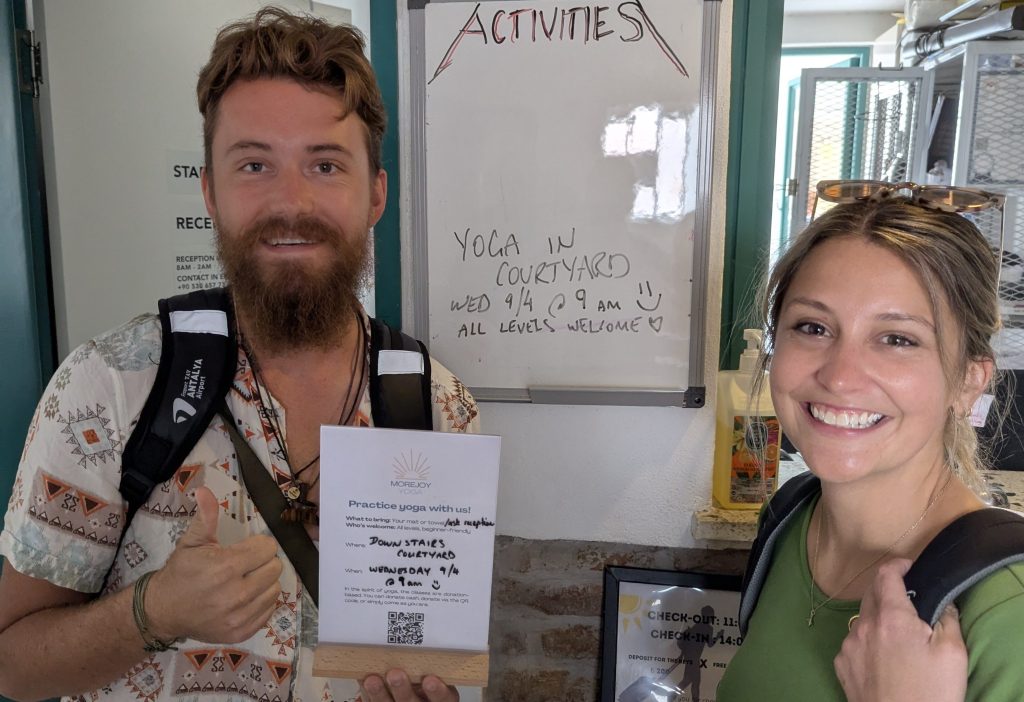
In 2025, James and I took a gap year and travelled the world with our lives in backpacks. There wasn’t much routine, but one thing stayed (somewhat) consistent: our yoga practice.
What changed constantly was where that practice happened. Without a home studio or familiar neighbourhood space, yoga became something we adapted again and again in hostels, beaches, parks, gyms, rooftops, yoga studios, and even boats.
Over time, one thing became very clear to me: much like a nice glass of wine, yoga becomes even better when paired appropriately. While yoga can be practiced anywhere, pairing the practice with the environment is an art and completely transforms the experience.
Here’s how that has shown up for me, both in my personal practice and in the classes I teach.
Nature
I love teaching and practicing in nature. Being amongst the greenery is always like a nervous system massage, even if an uncontrolled environment.
For me, teaching in nature is also creatively rich. There’s so much we can learn from the natural world about cycles, patience, resilience, impermanence – and theming classes around what’s happening in the environment often feels intuitive rather than forced. Nature offers metaphors everywhere if we’re willing to pay attention.
And as poetic as teaching in nature can be, we are also dealing with a hugely uncontrollable force. Weather changes, critters interact, and there are almost always passersbys. And while that might not bother you as a teacher, it’s important to remember not everyone feels comfortable closing their eyes or moving freely when they know they’re visible to the world.
I learned this early on while teaching on a beach, when a couple walked past mid-class and commented (loudly) on how awkward the class looked in happy baby pose. It was harmless enough, but feeling protective of the students it reminded me how a teacher’s role is to protect the emotional safety of the space as much as the physical one.
Since then, I’m more intentional. I choose shapes that feel contained when we’re out in the world. I offer options that keep people feeling grounded and supported. I encourage playfulness to help us feel at ease and at home, wherever we are.
Gyms
Gyms usually call for movement. They’re often colder, louder, and designed for output rather than inward focus. Trying to drop straight into stillness while treadmills are humming beside you can feel frustrating and challenging.
In these spaces, I gravitate toward more dynamic breath-led vinyasa and rhythmic practices. When movement syncs with breath, the external noise fades. The breath becomes the soundtrack.
Over this past year, we had an opportunity to teach at a gym. We had our hearts set on teaching a Slow Flow to Yin series, but knew the gym environment presented some challenges for this style. We negotiated an after hours time slot, when we could guarantee that no one would be lifting weights or jogging on a treadmill mid-class. We brought in lamps and candles, ran diffusers, turned up the heat and converted an energetic space into a quiet and inviting circle.
Because it was after hours, we were teaching quite late (late enough that we weren’t sure people would want to come). But the container we built matched the work. It had been built for slowing down, for exhale, for rest. And people felt that. They arrived, they settled, and they left their day at the door, and the were fully present. What we worried might feel inconvenient instead felt intentional.
Yoga Studios
To me, studios offer the greatest creative freedom. They usually come with warmth, props, and a shared understanding that yoga can be more than a purely physical practice. This is where I love to play: using blocks, bolsters, straps, walls, and the room itself to make asanas more accessible, more exploratory, and less fixed.
That same support extends beyond shapes. Studios tend to hold a certain warmth that shows everyone belongs as they are…whether they arrive early and chat, stretch in the corner, or simply lie down and rest. They naturally make space for practices that move beyond asana alone like breath, stillness, rest, and philosophy. It welcomes the whole experience, and fully holds it.
I felt this most clearly when I first became a student at my first studio, Body Flow. The space was light, bright, and playful (making it a perfect match for aerial yoga). I was greeted by the teacher by name, offered a cup of tea, and invited to set up my mat while others stretched, chatted, and moved gently through the silks as they waited for class to begin. It felt relaxed, inviting, and alive. The teacher consistently took time to make introductions and foster connection, and over time it became clear that this sense of community was part of the practice itself.
Hostels
Teaching yoga in hostels was one of the most challenging environments we worked in. Unlike parks, where disruption tends to move past you, hostels are intimate and unpredictable. People sat nearby sipping coffee, watching, or sometimes smoking mid-class. Space was limited, noise was constant, and the sense of privacy that often supports yoga simply didn’t exist. It required us to let go of control and rethink what a “container” could look like.
Many of the people who showed up had never practiced yoga before, and English wasn’t always their first language. Cueing needed to be simple, clear, and inclusive. Teaching in hostels made us focus less on beautiful sequencing and dharma talks, and more on adaptability and offering an entry point that felt welcoming for people who may otherwise never set foot on a mat.
One morning, we taught on a hostel rooftop. The night before, we’d met a group of British guys on night one of a boys’ trip. They enthusiastically agreed to come to yoga the next morning, but knowing they were looking forward to a big night, we didn’t expect them to hold to it. To our surprise, they set alarms and showed up. It was their first ever yoga class – they just never really thought about attending one or going to a studio didn’t seem appealing. Despite being a little bit dusty after a big night, they were enthusiastic about the practice – trying new things and being able to laugh on the mat. That was one of the most magical parts of teaching in hostels: connecting with people who would never have chosen to practice in a studio and who suddenly felt encouraged to try something new simply because their paths crossed with it.
Online
Teaching online has taught me just how much information lives in the room. When I’m teaching in a the same room as students, I’m constantly reading their body language, breath, and movements. Online, that feedback disappears. I’m often speaking into a screen, guiding a practice without seeing how it’s landing in real time.
Because of that, online teaching becomes more about describing than responding. I’m talking through a practice rather than teaching from what I can feel in the room. It requires clarity, trust, and a different kind of presence.
Practicing online, however, feels very different to me. As a student, I can intentionally create the space where I roll out my mat. I choose somewhere quiet. Away from distractions. I set the tone before I press play, maybe by lighting a candle, closing the door, or putting life on ‘do not disturb’ mode for bit. For me, an online practice works best when I remember that I am responsible for the container.
So where is the best place to practice?
I won’t hide the punch line – anywhere you practice is the best place to practice.
Yoga doesn’t require the perfect room, the perfect silence, or the perfect setup. If you’re waiting for that, you’ll never roll out your mat. Your practice meets you wherever you are. But different environments ask different things of our bodies, our breath, and our nervous systems.
As a student, noticing how a space makes you feel can help you choose a practice that supports you rather than frustrates you. Maybe a busy environment calls for movement. Maybe a quiet one invites stillness. Maybe practicing online works beautifully when you intentionally create a small pocket of calm at home.
As a teacher, we need to be aware of how our location may affect how students feel. How safe they do they feel to explore? How comfortable they are to rest? How easy is it for them to stay present? And asking ourselves how we can make the practice more accessible and more inviting.
It isn’t about finding the perfect space or moment to roll out the mat, nor is it about forcing the same experience into every room. It’s about listening, understanding, observing, and adapting.
 More Joy Wellness
Leave a comment